This manual presents the official rules of Vitorian Wars, a Trading Card Game set in a dieselpunk universe where grid tactics, industrial logistics, and archaic nobility meet in epic battles.
1. Welcome to the Great Theater of Nations
In Vitorian Wars, you take on the role of a Commander in a world where diesel engines and fire magic collide in strategic combat. Command your army, manage limited resources, and overcome your opponents in this tactical card game inspired by the propaganda war aesthetics of the interwar period. The Great War never ended. Your objective is to defeat the opposing Sovereign by reducing their Defense Stack to zero while managing your own resources to avoid logistical collapse.
2. The Battlefield (4×5 Grid)
The battlefield is organized into a grid with 4 rows and 5 columns, representing different combat zones:
Line 4: Opponent's Rear Guard (Enemy General Staff)
Line 3: Opponent's Vanguard (Enemy Front Line)
Line 2: Your Vanguard (Your Front Line)
Line 1: Your Rear Guard (Your General Staff)
Command Area:
Houses your Sovereign and Defense Stack (composed of 5 cards)
Displays the current Field Condition
3. Components and Deck Structure
Your army is composed of the following elements:
Sovereign (1 card)
Defines the color identity of your deck and grants access to and mechanics.
Maneuver Deck (50 cards)
Contains , Order cards, and . Maximum of 4 copies per card.
Defense Stack (5 cards)
Cards randomly drawn from your deck at the start of the match to serve as your protective "shield".
Supply Convoy (10 cards)
A separate deck containing your logistical resources, composed of Personnel and Supply cards.
4. Turn Structure
1. Logistics Phase
Ready your cards (unexhaust), supply new resources, and pay maintenance for elite units.
2. Main Phase
Mobilize new units, play Order cards, install Equipment (through the Link mechanic), and move troops between lines.
3. Combat Phase
Declare attacks and resolve confrontations following the combat protocol.
4. Final Phase
Resolve end-of-turn effects and perform battlefield cleanup.
5. Logistics System: The Diesel Economy
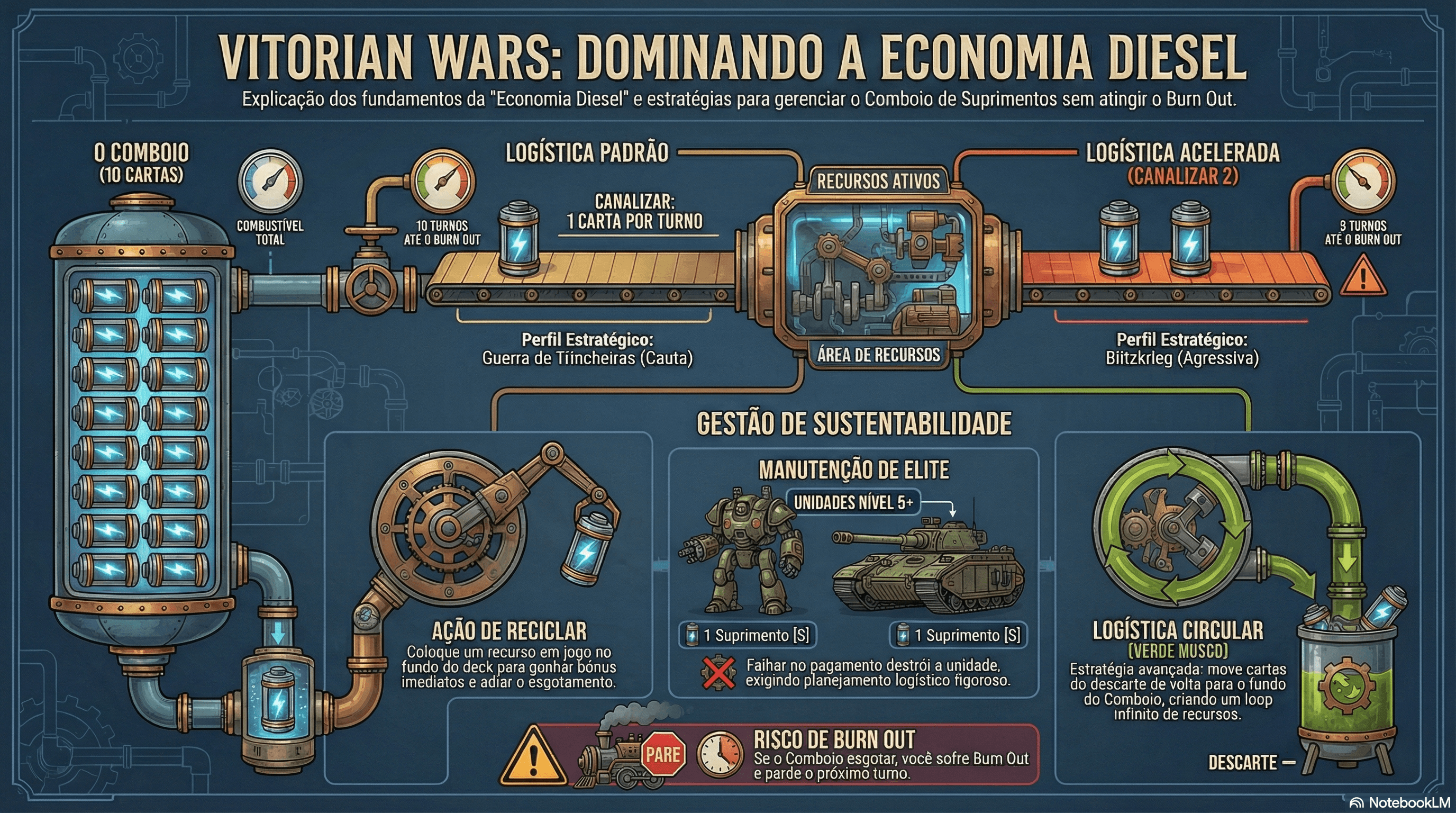
Resources are divided into two main categories: • [P] Personnel – used for recruitment and troop movement • [S] Supplies – used for fuel and machine activation
Supply Phase
At the start of each turn, reveal the top card of your Supply Convoy and add it to your available Resources Area.
Card Draw
After supplying, draw the top card from your Maneuver Deck to your hand.
Elite Maintenance
At the start of each turn, immediately after supplying, you must exhaust 1 [S] for each Elite Unit (Level 5 or higher) under your control. If you cannot pay this cost or choose not to pay it, the unit is destroyed and removed from the battlefield.
Recycling
You can place a resource in play at the bottom of the Convoy to activate immediate effects, such as Circular Logistics (which allows recycling cards from discard back to the deck) or gain temporary offensive bonuses.
Burnout
Critical state that occurs when your Supply Convoy has no cards to supply at the start of the turn., you lose your next turn and need to reshuffle the cards to form a new Supply Convoy, unless you use the Defense Sacrifice mechanic to convert protection cards into resources.
6. Tactical Movement System
Troop movement is a central element of strategy in Vitorian Wars. Using the 4×5 battlefield grid allows creating tactical advantages such as flanking and artillery support. The following rules detail how Sovereigns influence unit movement:
Fundamental Rules
When to move
Mobilization and standard movement of units between lines (Vanguard and Rear Guard) occur during the Main Phase.
How to mobilize
To position a unit from your hand onto the battlefield, choose an available position on the grid (4×5) and pay the costs indicated on the card during mobilization.
Movement cost
Moving troops already in the field generally requires Personnel [P] resources, representing the logistics necessary for repositioning.
Line limitations
Units can move between your Rear Guard (Line 1) and your Vanguard (Line 2) to position themselves strategically before combat.
Movement Keywords
Light
Units with this ability (common in the Sky Federation) move between lines without [P] cost.
Heavy
Larger war machines require a combined cost of [P] + [S] to change position.
Brute
Massive units that cannot change lines after mobilized, requiring precise initial positioning.
Ganking
Advanced ability that allows moving a unit to an adjacent column specifically to reinforce a combat already declared in the same phase.
Sovereign Abilities
- Forced March (Kemal Pasha – Red): Allows moving a unit to an adjacent column without cost when Recycling a Personnel resource.
- Evasive Maneuvers (Blue Sovereign): Allows moving a unit to any adjacent space (including diagonals) without [P] cost when performing a recycle action.
Kemal Pasha
Tactical Importance of Positioning
- Rear Guard Support: Units in the Rear Guard can exhaust 1 [S] to add their attack power to the unit in the Vanguard of the same column (Support Barrage), without needing physical displacement.
- Flanking: Positioning an ally in a column adjacent to the target reduces the enemy defender's attributes by -1/-1 during combat.
- Strategic Distribution: The manual encourages players to distribute their troops across the grid, avoiding excessive concentration in a single column to prevent impenetrable defenses and create surprise attack opportunities.
7. Combat Protocol
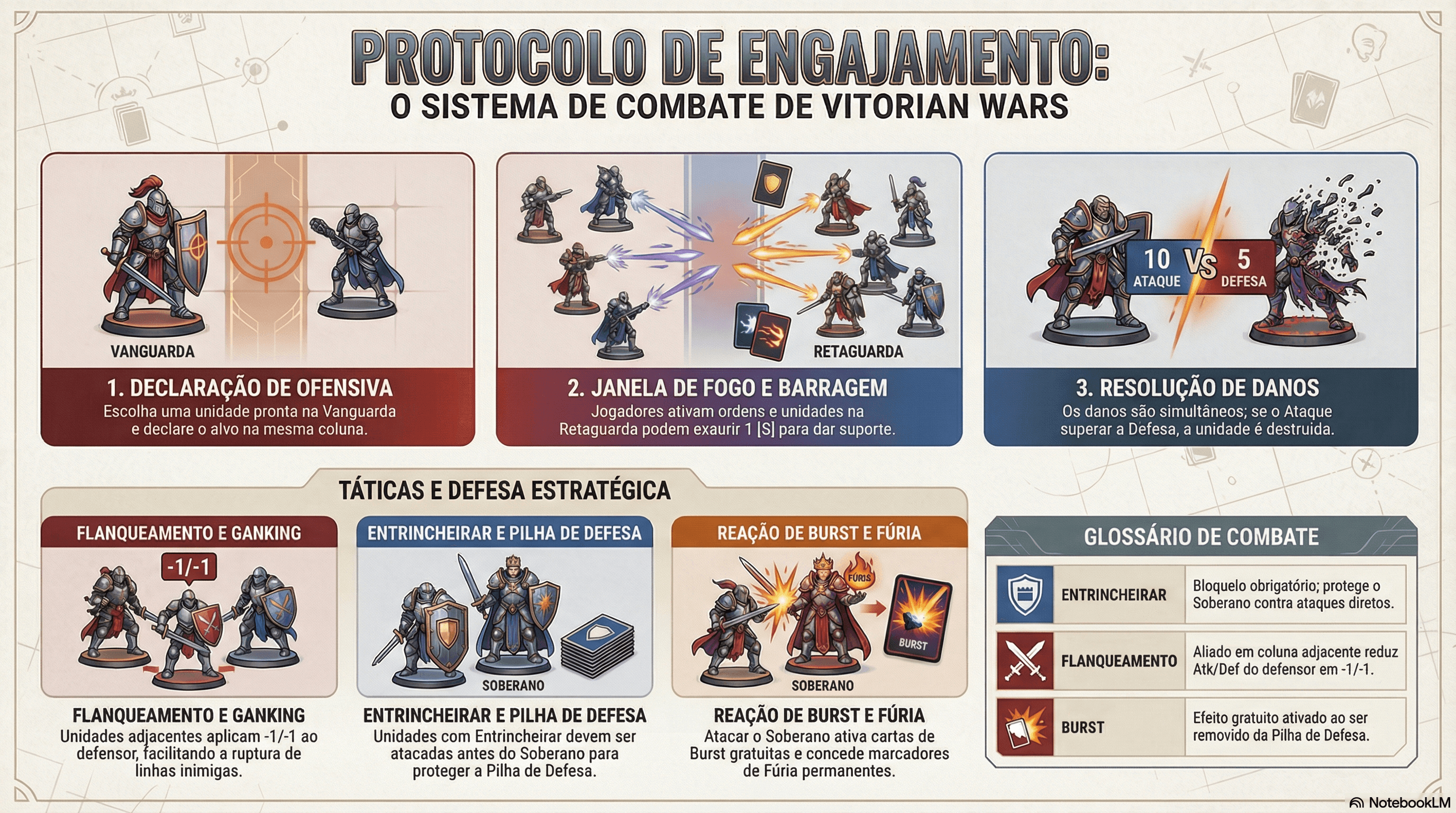
Combat follows a rigorous tactical sequence of 5 steps:
- 1
1. Offensive Declaration
Choose a ready (non-exhausted) unit in the Vanguard to attack an enemy unit in the same column or the opposing Sovereign.
- 2
2. Response Window (Chain of Command)
Both players can respond with Order cards or activate abilities, forming a resolution stack (LIFO – last in, first out).
- 3
3. Support Barrage
Units in the Rear Guard can exhaust 1 [S] to add their attack power to the fighting unit in the same column.
- 4
4. Damage Resolution
Damage is calculated simultaneously. If the attack is greater than or equal to defense, the unit is destroyed.
- 5
5. Burst Reaction
If the Sovereign is hit, reveal the top card of the Defense Stack. If it has the Burst keyword, its effect is activated for free.
8. Advanced Tactics
Flanking
When an allied unit occupies a column adjacent to the target, the defender suffers -1/-1 to their attributes during combat.
Ganking
Ability that allows moving a unit to an adjacent column to reinforce a combat in the same turn.
Entrench
Units with this ability must be attacked mandatorily before the Sovereign can be targeted for direct attacks.
Armor Piercing
Excess damage after destroying a defender is applied directly to the enemy Defense Stack.
9. Sovereign's Fury System
Whenever you lose a card from your Defense Stack, your Sovereign receives a Fury marker. As Fury accumulates, the Commander grants increasingly powerful passive bonuses, such as +1 Attack for all units or cost reduction for abilities described in the Commander's abilities, allowing dramatic turnarounds in the late game.
10. Colors and Archetypes
The color system defines the identity of dieselpunk nations and the construction strategy of each army. Each deck is linked to a Sovereign, whose colors determine which cards can be included. Meet the four main nations and utility colors:
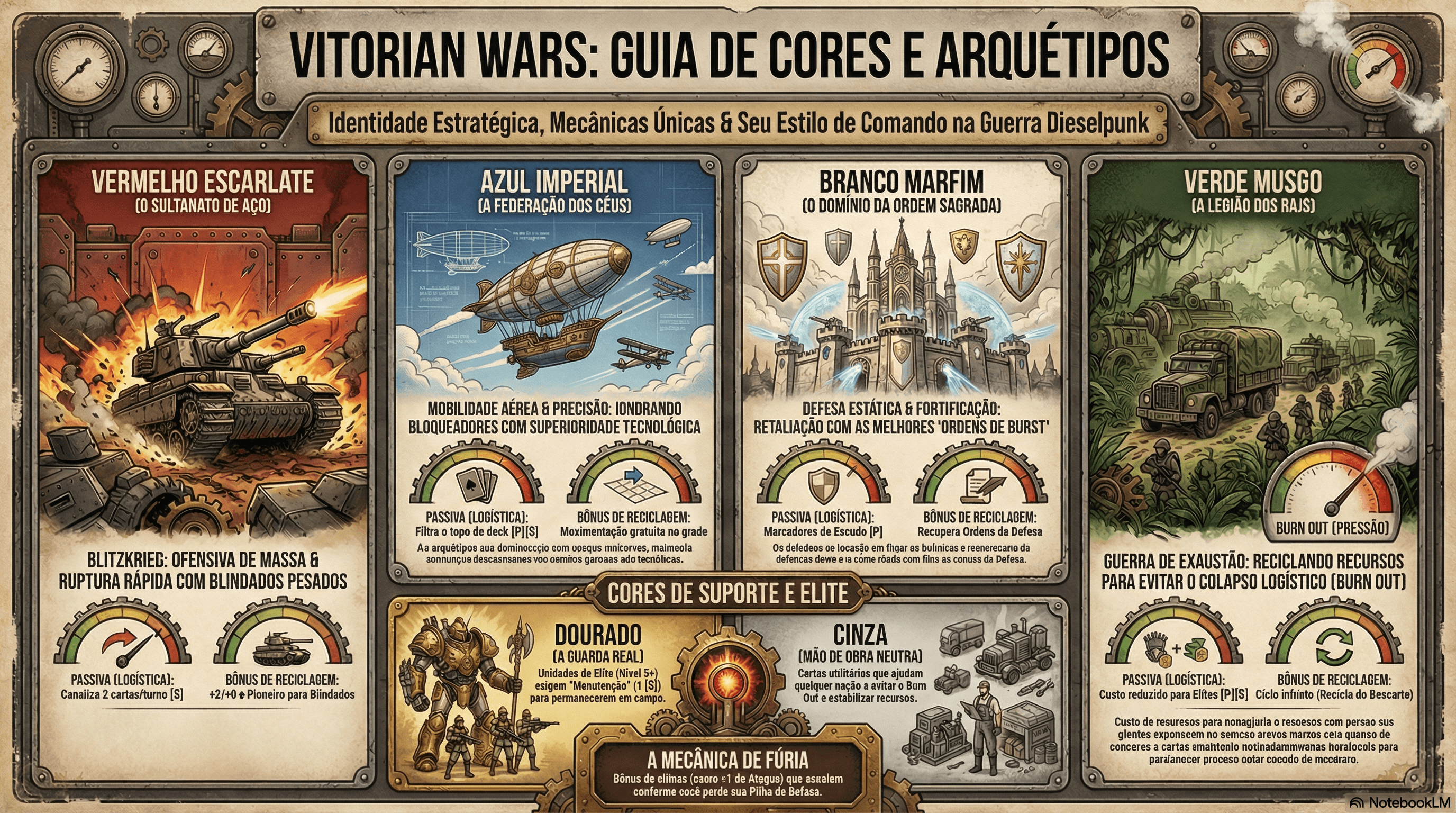
Scarlet Red – The Steel Sultanate
Theme: Industrial power, smoking chimneys, and relentless offense.
Archetype: Mass offensive and line breaking.
Strategy: Focus on units with Bayonet Charge (attack immediately upon entering the field) and Armor Piercing, dealing direct damage to enemy defense after destroying defenders.
Sovereign: Industrial Blitzkrieg passive ability allows supplying 2 resources per turn, accelerating the economy in exchange for greater Burnout risk. Fury grants attack bonuses to units.
Imperial Blue – The Sky Federation
Theme: Aerial aristocracy, technological superiority, and flight mages.
Archetype: Aerial mobility and precision strikes.
Strategy: Uses the Light and Swift keywords, allowing units to change lines without cost and attack without exhausting. Aerial Observers perform Long Range attacks ignoring ground defenders.
Sovereign: Industrial Blitzkrieg passive ability allows supplying 2 resources per turn, accelerating the economy in exchange for greater Burnout risk. Fury grants attack bonuses to units.
Ivory White – The Domain of the Sacred Order
Theme: Religious nationalism, State purity, and capital defense.
Archetype: Static defense and fortification.
Strategy: Centered on units with Entrench (mandatory blockers) and Reactive Armor, which doubles defense during combat.
Sovereign: Industrial Blitzkrieg passive ability allows supplying 2 resources per turn, accelerating the economy in exchange for greater Burnout risk. Fury grants attack bonuses to units.
Moss Green – The Raj Legion
Theme: Colonial resilience and war of attrition.
Archetype: Logistical superiority and elite units.
Strategy: Focus on Heavy and Brute units with high defense values to dominate the field for extended periods.
Sovereign: Industrial Blitzkrieg passive ability allows supplying 2 resources per turn, accelerating the economy in exchange for greater Burnout risk. Fury grants attack bonuses to units.
Utility Colors
Gold (The Royal Guard): Elite cards requiring high logistical costs. Function as "finishers" or amplifiers of the Sovereign's Fury abilities.
Gray (Neutral Workforce): Militias and basic equipment without national identity. Function as the "gears" of the game, helping any deck generate [P] or [S] icons and return cards to the Convoy to avoid burnout.